By NELLIE SETEPANO | POST COURIER (edited)
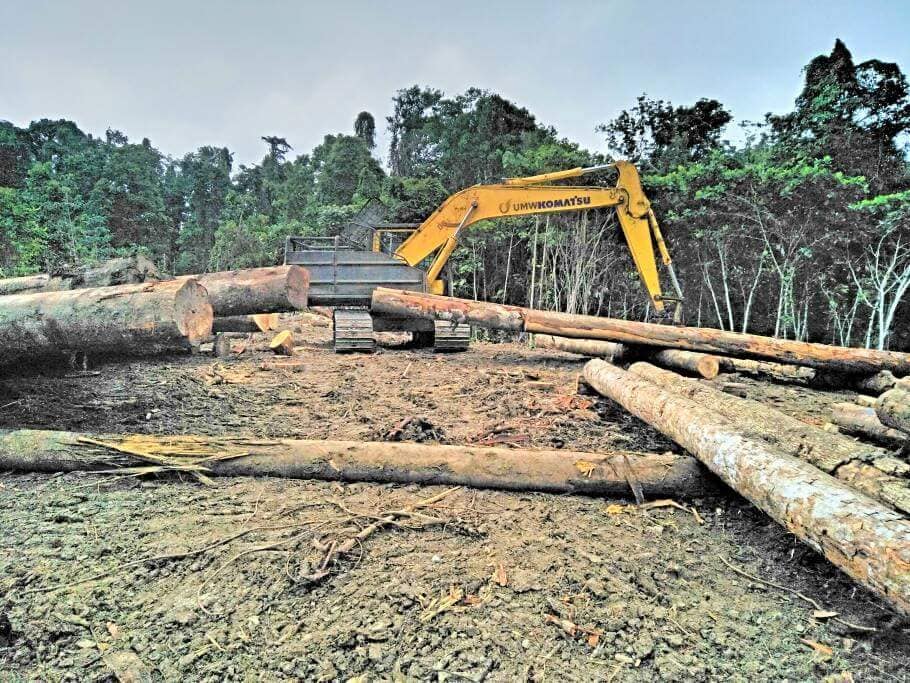
AN illegal logging company operating in Northern Province was shut down and 13 Asians without work permits were locked up at the Popondetta cells.
Northern Province Police have confirmed the shutdown of the illegal logging company known as Northern Forest Products at Collingwood Bay, Wanigela with thousands of logs and heavy equipment impounded. All logs and equipment will be moved to Oro Bay.
Provincial Police Commander Chief Inspector Lincoln Gerari said police had acted on advice from PNG Forest Authority (PNGFA) to move onto the site and shut it down after its illegal operations on 45,000 hectares state land that consists of portions 135, 136 and 137.
“We moved in last Friday and caught them off guard, the Asians were cooking pumpkins, and then fled into the bushes and our men went after them,” Gerari said.
When caught, the men complained that they were never fed properly and or paid by the site manager since arriving last September.
Police said the loggers arrived with no legal entry permits and are now arrested and charged under the Employment of Non-Citizens acts 2007.
Aged between 28 to 50 years; 12 of the men are from Malaysia and one from Indonesia. This section provides for prohibition of employment without valid work permit. Separately, the site manager was charged for stealing logs on state.
According to police, the provincial government had a keen eye on the operations of the company that had entered into a partnership with landowner group called Aiso [Assor] Development Corporation under the pretext of doing agricultural business and growing cash crops like cocoa.
Northern Governor Garry Juffa who has been aware of the illegal operations and had brought the issue to the attention of PNG Forest Authority and ensured the shutdown happened.
He also visited the site after the raid and confirmed the shutdown. Mr Juffa talked to the villages and assured those involved will be prosecuted. The governor has been vocal about illegal aliens operating in the province and vowed to remove them. – Via Garamut News.

Extracted from MONGABAY NEWS | EDITED
The leaders of Central Island province, part of the Solomon Islands in the South Pacific, have decided not to issue new business licenses to logging and mining companies following a local petition and recent reports detailing the lack of sustainability and legality in the country’s logging sector.
Local and international organizations have blamed unsustainable and corrupt logging practices for destroying the islands’ sensitive habitats and creating civil strife among the people who live there.
Provincial governments in the Solomon Islands lack the power to block logging outright, leading Central Island province to take the licensing approach to stop new operations.
Central Island province in the Solomon Islands has blocked new logging and mining operations in an apparent attempt to halt the degradation of the archipelago’s sensitive ecosystems.
“With timber on the islands harvested at a hugely unsustainable rate, this is an important first step,” the London-based watchdog organization Global Witness tweeted on Jan. 14, 2019.
Timber accounts for nearly one-third of the Solomon Islands’ exports, according to a 2013 study by the World Bank.
In October 2018, Global Witness reported that companies were cutting down the country’s trees at a rate that was 19 times what could be considered sustainable.
The organization also found that more than 12,600 kilometers (7,800 miles) of logging roads snake through the country’s land area.
Central Island province, also called Central Islands or just Central province, is home to Tulagi, the colonial capital of the Solomon Islands, a group of islands stretching east of Papua New Guinea across 1.34 million square kilometers (520,000 square miles) of the South Pacific.
The national government holds the power to permit logging in the country, Patrick Vasuni, the province’s caretaker premier, told ABC Radio Australia. (Vasuni is officially a “caretaker” until the upcoming elections, expected in 2020.)
But companies must also obtain business licenses from provincial governments before they begin operations.
“That is the area we are banning,” he said, adding that the injunction came on the heels of a local petition to halt logging in the province.
Vaeno Vigulu, who heads the country’s forestry ministry, confirmed by text message to ABC Radio that the order hadn’t come from his agency.
Conservation groups have long warned that logging and mining are destroying highland, rainforest and coastal habitats throughout the country, along with inciting societal strife.
Global Witness’s investigation found that 82 percent of the Solomons’ exported logs end up in China, with much of it potentially having been harvested illegally, unsustainably, or both.
Meanwhile in Papua New Guinea, the Government is yet to publish a list of Special Agriculture Business Lease (SABL) obtained illegally.
It is publically known from the findings of the SABL Inquiry, that the land (some 5.3 million hectares of customary land) was leased illegally, without free, prior informed consent of the customary landowners (CLOs).
The Government has made a commitment of returning it to the landowners (legally it belongs to them anyway), but there's another angle also to consider. It is now taking five (5) years, the promise is not honored.
This action, or attempt to disenfranchise the landowners and steal their logs in many cases, was knowingly perpetrated across the country in a short period of time by a band of people.
This entailed officials working with a few customary landowners, sometime from elsewhere and purporting to be landowners from that land, together with a group of foreigners, who sometimes had the privilege of travelling back and forth from Malaysia in considerable executive comfort, we're led to understand.
If one robs a bank, or burgles a house and are caught there's inevitably a long spell in Bomana, Baisu or such facilities.
So, what about these land grabbers, is anyone (i.e. the police) progressing to put them behind bars?
It's not exactly a secret who they all were.
Many in PNG and globally are pushing for the Government to publish the full SABL list, it is one of the world’s biggest illegal land grabs, yet more than 5-years after the government promised to cancel the SABL Leases and return the rights back to the CLOs and nothing happen to date.
People are still waiting earnestly to hear the leases being cancelled.
It is also reported by local and international NGOs that the SABL leases, some of which land areas are largely covered by forest, being used to for carbon trading deals.
Over 50,000 square kilometres of land was stolen using illegal SABL leases between 2003 and 2011, since the Commission of Inquiry reported in 2013 the only leases confirmed as cancelled have been on the orders of the court. – Via Garamut News.